Microsoft Fabric September 2026 Update
Of the announcements at FabCon Barcelona, Fabric Policies is the one I’d explore first. As more teams use Fabric, a practical question comes up: how do you give people room to build while keeping control of decisions like sharing data outside the organization?
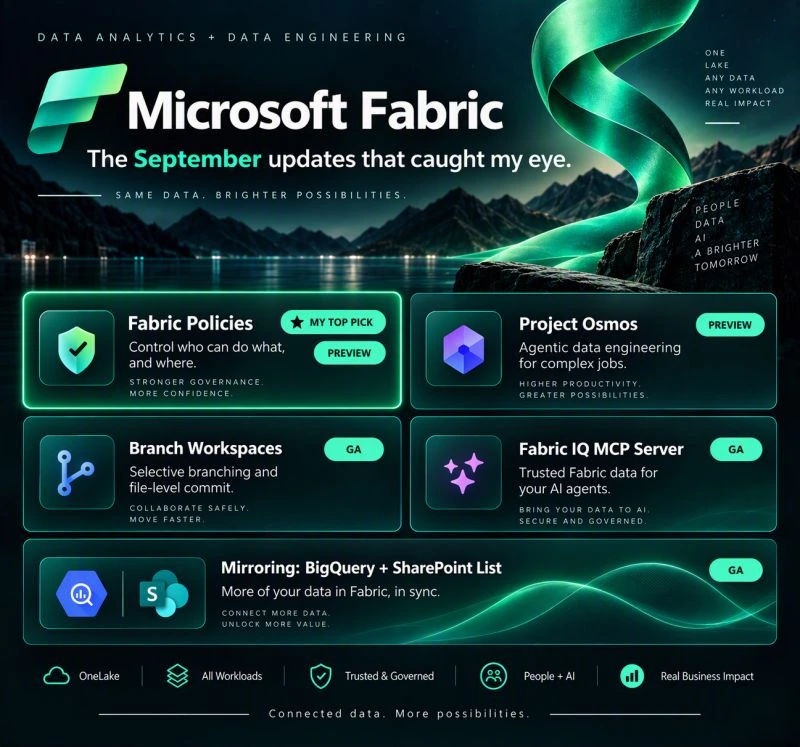
My top pick: Fabric Policies
The September preview gives admins finer control over which actions are allowed, who can take them and where a policy applies. It covers item creation, external data sharing and workspace settings, with controls at the capacity and tenant levels.
What I like is the ability to treat those decisions separately. A team might need the flexibility to create items for a new analytics project, while IT still needs to govern external sharing. Defining those boundaries explicitly makes it easier for teams to understand what they can do as the platform grows.
Project Osmos and the engineering workflow
The Project Osmos preview showed an agentic approach to a complex data engineering project. In the Claims 360 demo, the starting point was 20 sources and 261 tables. The work extended from building notebooks to validating and reconciling data, then using it for forecasting. The part I’d look at most closely is the build, test and validation cycle: when you bring that many tables together, checking the result is a substantial part of the job.
More selective development and deployment
Branch Workspaces and Selective Branching reached general availability. A developer can isolate work and branch just the Fabric items a change needs. Deployment plans and file-level commits, both in preview, give teams finer control over what moves forward. That’s valuable when one change is ready for review while another is still in progress.
Trusted context for agents and more sources for OneLake
The Fabric IQ MCP Server reached general availability, giving AI clients and agents a standard way to access trusted Fabric data, reports and semantic models with their business context. Mirroring for Google BigQuery and SharePoint Lists also reached general availability, making it possible to keep more external data synchronized with Fabric.
Taken together, these updates explain why governance is my first pick. As more sources feed the platform and more tools consume its data, being explicit about who can do what becomes even more important.
Understanding a governance policy in practice
A useful way to think about a policy is as a decision about a particular action in a particular context. Microsoft’s Fabric policies overview describes rules that consider conditions such as workspace, security group and sensitivity label. The policy scope and its active rules matter; a broad statement such as “this team can use Fabric” does not explain every operation the team may perform.
For example, imagine a development team exploring a non-sensitive training dataset while another team manages financial reporting. My starting exercise would be to write down the intended action, the relevant group and the workspace for each case. Then test both an allowed scenario and a scenario that should be blocked. This makes the desired behavior concrete before more people depend on it. I would also record who owns the policy and how a legitimate exception should be reviewed.
Why branching still needs validation
Microsoft’s Fabric CI/CD guidance explains how version control and separate development environments help teams coordinate changes. Selective branching narrows the set of items involved, but it does not remove the need to understand dependencies and environment-specific configuration.
Consider a change to a revenue measure. The developer should review the semantic model change, verify the affected report and compare results against a known test dataset before release. If the model depends on a changed table or connection, that dependency belongs in the review too. My preference would be a small, explainable release with a clear validation record.
The same discipline applies to AI-generated engineering work. A generated notebook can look convincing while using the wrong join or aggregation grain. I would ask for expected row counts, reconciliation totals and deliberately difficult test cases before accepting its output. Automation becomes more useful when the team can explain how it checked the result.