Fabric Security and Medallion Architecture in Toronto
Toronto Fabric & Power BI User Group · April 1, 2026 · Long View Systems, Toronto
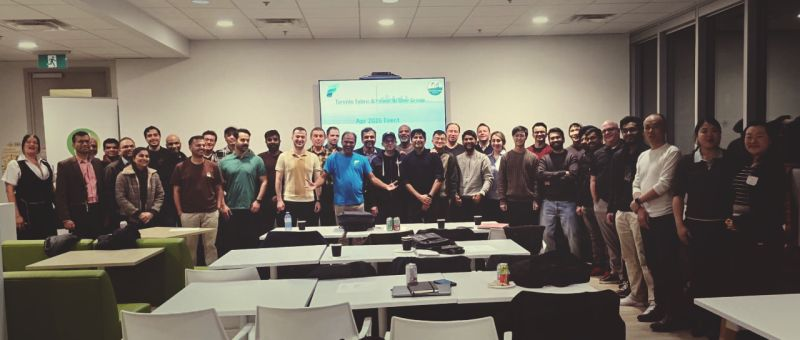
The April gathering of the Toronto Fabric & Power BI User Group brought a full room together to explore two closely connected questions: how do we turn raw data into trustworthy analytics, and how do we protect that data throughout the journey? Hosted and sponsored by Long View Systems at its Toronto office, the evening offered practical perspectives on architecture and security in Microsoft Fabric.
Mitul Tailor on medallion architecture
Mitul Tailor, Senior Data Engineer at Long View Systems, explored implementing medallion architecture across Lakehouse and Data Warehouse environments. The official event agenda described a real-world implementation using reusable pipeline templates and modular code to accelerate delivery of Bronze, Silver and Gold layers.
For readers new to the pattern, the layers represent stages of data preparation. Bronze preserves incoming source data. Silver improves its quality through cleaning, standardization and validation. Gold organizes the resulting data for a business purpose, such as reporting and analysis. Microsoft’s medallion architecture guidance explains how these layers can be separated into lakehouses or warehouses within OneLake.
A simple example I would use to explore the idea is a sales dataset. I would retain the incoming order records in Bronze, standardize dates and resolve duplicate order identifiers in Silver, then prepare sales facts and customer or product dimensions for reporting in Gold. That example is an illustration of the pattern, rather than a reconstruction of Mitul’s demonstration. Separating the stages makes it easier to investigate whether a reporting issue began in the source, a transformation or a business definition.
The reusable-template approach also raises a useful design question: which parts of a pipeline stay the same across datasets, and which need to be configured? I would start by separating common validation and logging steps from source-specific rules. For me, that is where the architecture becomes a repeatable way of delivering analytics, beyond simply naming three layers.
Vengatesh Parasuraman on Fabric security
Vengatesh Parasuraman, Principal Program Manager at Microsoft and a security specialist in the Fabric CAT team, shared an overview of Fabric security and the controls organizations can use to govern their data. His session connected the platform’s built-in protections with the configuration decisions that remain important for each organization.
Microsoft’s Fabric security overview provides helpful background: identity is handled through Microsoft Entra ID, data is encrypted at rest and in transit, and organizations can configure additional access and network controls. Governance capabilities, including lineage and information protection labels, help teams understand and manage their data. These controls address different questions; a protected connection alone does not determine which information a particular user should be allowed to see.
For an analytics project, I would translate that into a practical review of who needs access, what they need to do and which data they need. A report consumer and a pipeline developer may have very different responsibilities. I would test the intended experience using representative user accounts and check the relevant access paths, rather than assuming that a report displaying correctly proves the entire solution is configured correctly.
Bringing architecture and security together
My main takeaway is that data quality and access design belong in the same conversation. As data moves toward a reporting-ready layer, teams should also be clear about ownership, intended consumers and how access is reviewed. A useful next step for my own learning would be a small medallion example with documented quality checks and an access matrix, so both the data flow and the responsibilities are easy to explain.
Thank you to John Kaus and the Long View Systems team for their hospitality, and to Ashraf Ghonaim, Microsoft Fabric MVP and organizer of the Toronto Fabric & Power BI User Group, for continuing to build this community. Thanks as well to the speakers and everyone who contributed questions and conversations throughout the evening.
Read my original event post on LinkedIn ↗
Photos from the day